
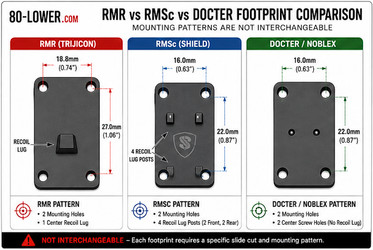
RMR Footprint vs RMSc & Doctor
Aug 26th 2026
If you've shopped for a red dot lately, you've probably noticed that not every optic fits every slide. That's because red dots aren't built on one universal mounting pattern — they're built on a handful of competing "footprints," and picking the wrong one means your new optic sits in a box instead of on your pistol.
We get this question a lot from builders finishing out a P80 slide or shopping for their first micro red dot: "Will this optic fit my cut?" Here's a breakdown of the three footprints you'll run into most (RMR, RMSc, and Doctor) and which optics go with which.
What Is an Optic "Footprint," Anyway?
A footprint is just the screw hole pattern and mounting profile machined into your slide. Optic manufacturers design their sights around a handful of established footprints so aftermarket slides and aftermarket optics can standardize around them instead of every company inventing its own screw pattern. Match the footprint on the box to the cut on your slide and the mounting screws line up. Mismatch them and they don't, and no amount of force is going to fix that.
Here are the three you'll see most often on modern optics-ready pistols.
RMR Footprint
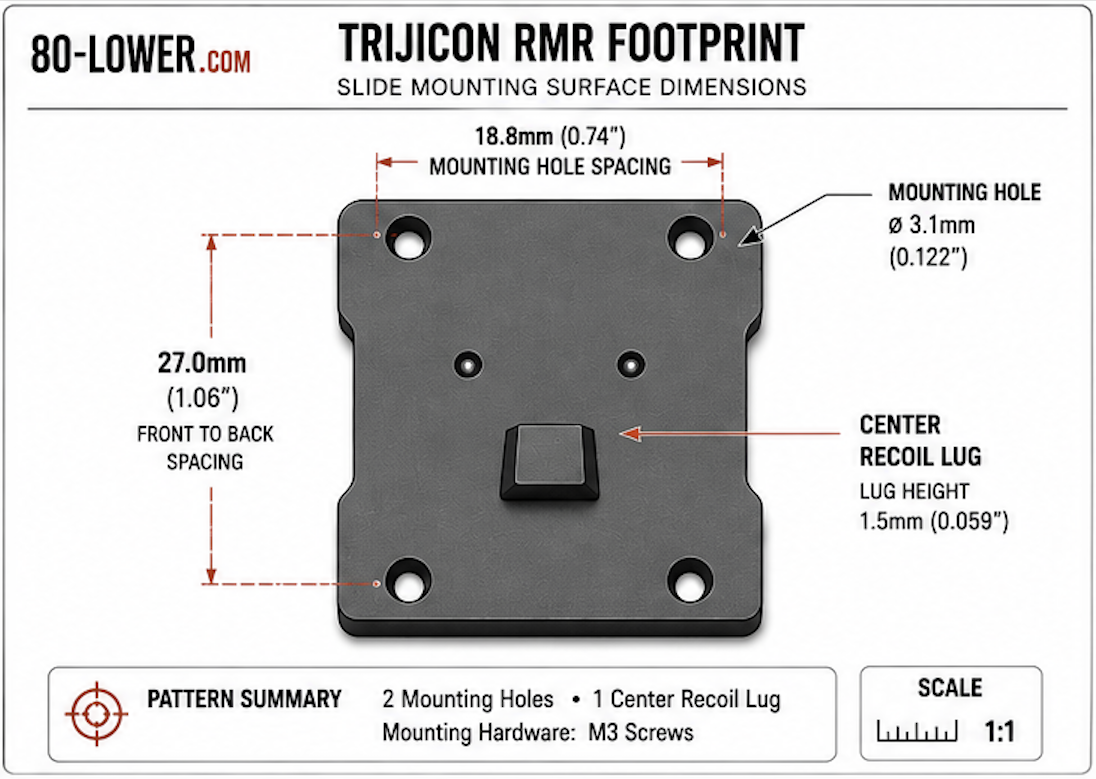
Trijicon designed the RMR (Ruggedized Miniature Reflex) footprint, and it's become something like the industry standard for full-size and duty pistols. It's a taller, wider footprint with a stout recoil lug, which is exactly why it shows up on guns expected to run thousands of rounds without the optic walking loose.
Optics that use the RMR footprint include:
- Trijicon RMR / RMRcc (note: these are not the same footprint as each other — more on that below)
- Trijicon SRO
- Holosun 507C / 508T
- Swampfox Sentinel and several other Swampfox models
If your slide is cut for RMR, you've got the widest selection of full-size, combat-proven optics to choose from.
RMSc Footprint
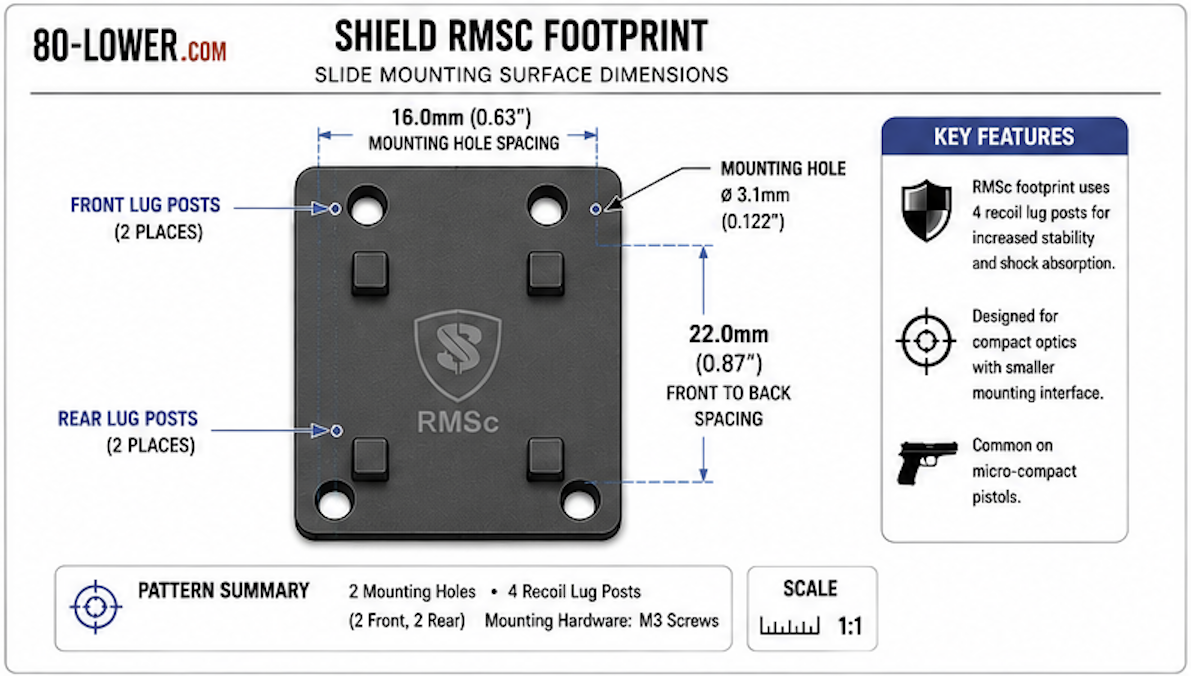
Shield Sights developed the RMSc footprint for its compact RMS line, and it's since become the go-to standard for subcompact, concealed-carry pistols like the Glock 43X/48 MOS and most milled P80 subcompact slides. It's a smaller footprint than RMR, which keeps the optic's frontal profile low and holster-friendly.
Optics that use the RMSc footprint include:
- Shield RMSc
- Holosun 407K / 507K / EPS Carry
- Vortex Defender-CCW
- The enclosed-emitter version of the Vortex Venom
If you're building a carry gun and slimming down your slide's optic window matters to you, RMSc is almost always the cut you want.
Doctor Footprint
The Doctor footprint gets its name from the old Docter (now Noblex) optic line, and it sits in between RMR and RMSc in terms of size. It's been around long enough that a wide range of mid-size dots have adopted it.
Optics that use the Doctor footprint include:
- Burris FastFire series
- Vortex Viper and the non-enclosed Vortex Venom
- Viridian RFX25
Doctor-pattern optics tend to be a favorite for shooters who swap the same dot between a few different guns, since the footprint shows up across pistols, some shotguns, and even a few rifle-mounted applications.
The RMR/RMRcc Mixup (Don't Make This Mistake)
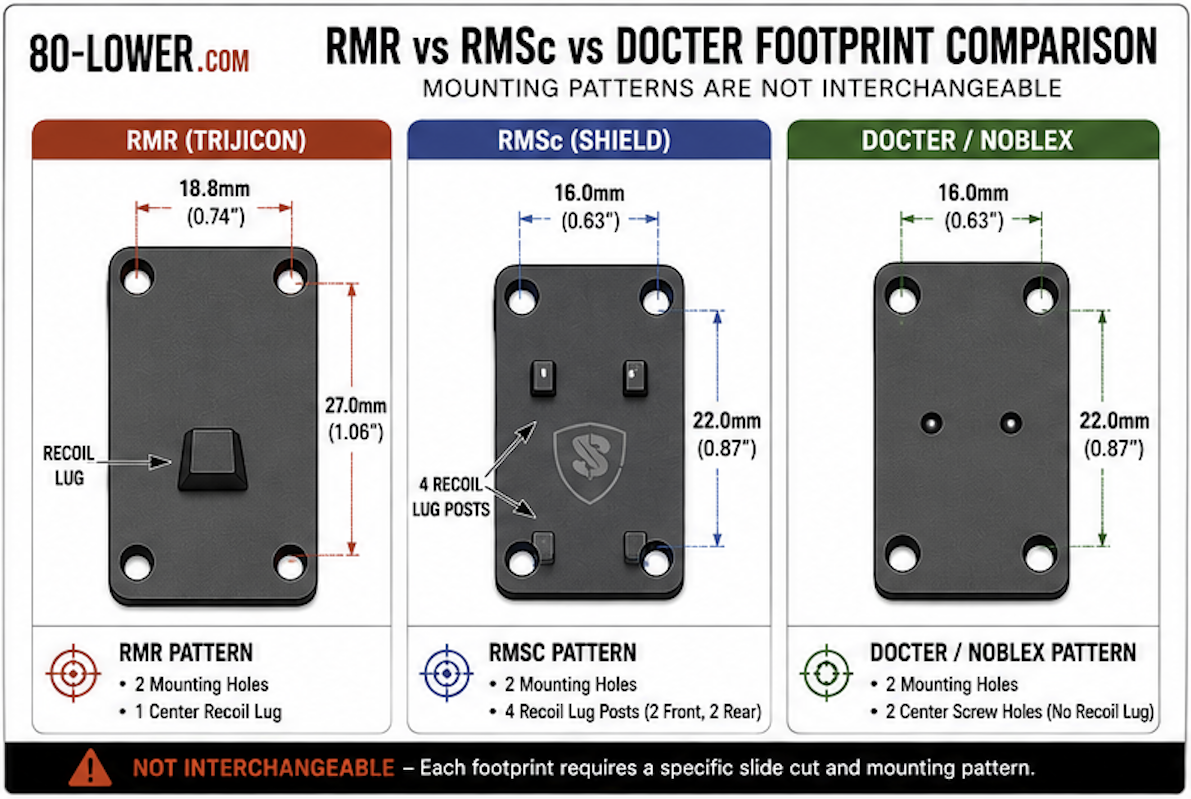
This is the one that trips people up most: the RMR and RMRcc do not share a footprint. They look similar, they come from the same manufacturer, and the names are one letter apart — but the screw spacing is different (18.8mm on the RMR vs. 15.7mm on the RMRcc), and the recoil lug setup doesn't match either. If your slide is cut for a full-size RMR and you try to drop in an RMRcc, you'll need an adapter plate to make it work. Always check which specific cut your slide has before you buy — "RMR-cut" and "RMRcc-cut" are not interchangeable claims.
Two Popular Optics, Head to Head
The Doctor footprint covers a lot of ground, so it's worth zooming in on two of the most common optics people ask us to compare: the Vortex Venom and the Trijicon RMR.
Battery life: This one isn't close. The Venom is rated for up to 30,000 hours on its lowest brightness setting, thanks to its efficient emitter and automatic shutoff. The RMR is no slouch, but it wasn't designed to chase runtime numbers — it was designed to survive.
Durability: The RMR has a two-decade track record on duty and combat pistols, and its housing reflects that — thick, low-profile, built to take a beating and keep zero. The Venom holds up fine for range use and daily carry, but it hasn't earned the same reputation for absorbing abuse that the RMR has.
Battery access: The Venom uses a top-loading battery tray, so you can swap batteries without removing the optic from the slide — handy if you're worried about losing zero every time the battery dies. The RMR's battery sits underneath the optic, which means a full dismount to change it.
Glass and dot: Both give you a clean, crisp dot with minimal distortion. The Venom's window is a touch larger, which can make faster target transitions a little easier, especially for newer shooters still building their presentation.
Price: The Venom is the clear value pick, giving you most of what a shooter needs at a lower price point. The RMR carries a premium, and that premium mostly comes down to its track record.
If you're building a home-defense or range gun and want a lot of optic for the money, the Venom is hard to argue with. If you're building toward duty-grade reliability, the RMR is still the benchmark it's been for years.
Which Footprint Should You Build Around?
If you're not sure where to start, work backward from the gun:
- Full-size or duty-oriented build? Go RMR. You'll have the deepest selection of proven, heavy-duty optics.
- Subcompact or carry build? Go RMSc. It keeps your optic compact and holster-friendly, and options like the Holosun 507K are purpose-built for this footprint.
- Already have a dot from another gun you want to reuse, or want maximum optic flexibility down the road? Check if it's Doctor-pattern — there's a good chance your next build can be cut to match.
Whatever footprint you land on, confirm the cut before you buy the optic, not after. It's a lot cheaper to double-check a spec sheet than to buy an adapter plate you didn't plan for.
As always, make sure any build you're working on complies with all applicable federal, state, and local laws. This article is for informational purposes only and isn't legal advice — do your own research before you build.
DISCLAIMER: If you are new to the world of DIY gun building, you likely have a lot of questions and rightfully so. It’s an area that has a lot of questions that, without the correct answers, could have some serious implications. At GunBuilders.com, we are by no means providing this content on our website to serve as legal advice or legal counsel. We encourage each and every builder to perform their own research around their respective State laws as well as educating themselves on the Federal laws. When performing your own research, please be sure that you are getting your information from a reliable source.